

Blog
What Size Spinning Reel for Bass? (The Ultimate Real-World Gear Guide)

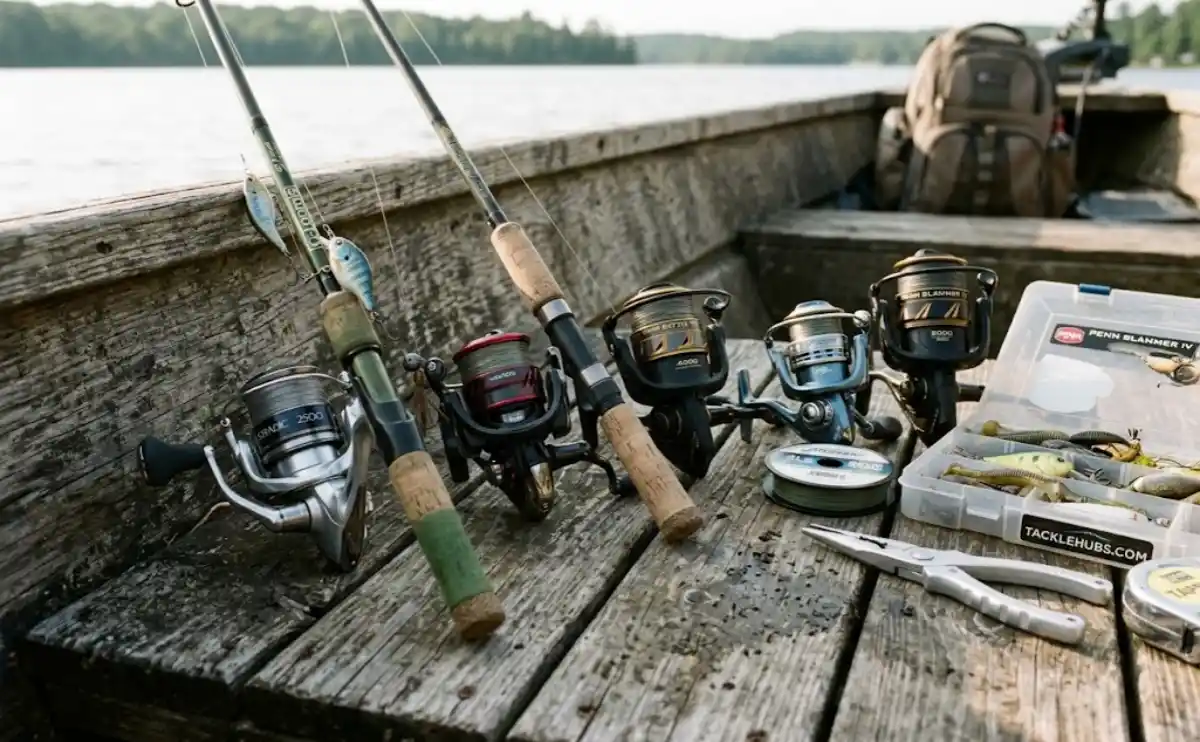
You’ve got your rods ready, your lures are shining, and you are dialed in for that monster Bass strike. But before you make that first cast, one massive question looms over your gear selection: What size spinning reel for Bass is the absolute best?
Ask three anglers, and you’ll get four opinions. Manufacturers don’t make it easy, with overlapping 2000, 2500, 3000, and 4000 sizes. If you get it wrong, you’re looking at bad line management, poor casting distance, and worst of all—a reel that either gets bullied by a big fish or is too heavy to use all day.
As both a veteran eCommerce SEO and an angler who lives for the thump of a Bass on light line, I have seen it all. I have tested these sizes side-by-side on the water. Today, I’m cutting through the marketing noise to give you the honest, on-the-water truth. We’re going to find the one size you really need, and the specialized situations where you might want to switch.
The Short Answer: The Sweet Spot
If you are just looking for the quick verdict to buy right now, here it is:
A 2500 or 3000-sized spinning reel is the optimal choice for Bass fishing in 90% of situations.
These two sizes offer the perfect blend of line capacity, drag power, physical weight, and versatility to handle all the standard Bass techniques—from finesse plastics to light topwaters. For Bass, the 2500 is your workhorse.
➡️ Discover Our Hand-Picked 2500 Bass Spinning Reels (Shop Now!) ➡️
Now, let’s dive into why these sizes dominate and when you should deviate from the norm.
Understanding Spinning Reel Sizing (The Industry Standard)
First, let’s get the standard sizing down. While brands like Shimano and Daiwa have subtle differences, the general scale is linear. For Bass, you are only considering a few specific options:
-
2000: Primarily Ultra-Light. Used for Panfish, Trout, and extreme finesse Bass (drop shotting in open water).
-
2500: The All-Around Champion. Moderate capacity, lightweight body, strong drag.
-
3000 (often 3000-C): The Robust Contender. Same body size as the 2500 (hence the ‘C’ or Compact), but with a deeper, larger spool for more line.
-
4000: Heavy Duty. Best for large swimbaits, heavy cover, or targeting big striped bass/saltwater inshore.
The difference in physical size and weight between a 2000 and 4000 is immense. The difference between a 2500 and 3000, however, is often just the spool dimensions.
Deep Dive: The Perfect Pairs
Let’s analyze when the workhorse wins and when to upscale.
🏆 The 2500: The Finesse Master
If your standard Bass fishing involves techniques like Drop Shots, Ned Rigs, Wacky Wigs, and small shaky heads, the 2500 size is non-negotiable.
Why It Rules Finesse: Finesse Bass techniques rely on light line (4lb to 8lb fluorocarbon main line or a light braid-to-fluoro leader). A 2500 reel is lightweight, often scaling in at 6.0 to 7.0 ounces for premium models. This balances perfectly on the specialized, lighter-power rods used for these baits. You do not need a deep spool when casting a 1/8 oz Ned Rig 40 feet. The 2500 offers smoother, precise drag systems critical for landing big fish on ultra-thin lines.
The Test: When testing drop shots on Lake Champlain, I switched between a 2500 and 3000. The weight difference (minor) and better balance of the 2500 made me more efficient all day, and its drag managed the powerful surges of the fish much smoother on the 6lb test.
🥈 The 3000: The Power Versatility
The 3000 is your go-to when you need the finesse of a 2500 but also need more power, longer casts, or thicker line. If you use tubes, small swimbait heads, light jerkbaits, or spy baits, you need to upscale.
Why It Wins Power: The compact 3000 (like a “3000-C”) has the same frame but a wider/deeper spool. This wider spool does two things: 1. It creates larger coils, reducing memory and allowing for significantly longer casts. 2. It holds much more line, which is crucial if you are fishing for larger Smallmouth or if you are spooling up with braid as your main line (like 10lb or 15lb braid). The wider spool also means a slightly larger drag stack, offering an extra pound or two of stopping power.
The Test: During a tournament on a river system where we needed to bomb small swimbaits 100+ feet to reach spooky fish, the 3000 excelled. The wider spool allowed the bait to carry momentum much further.
Special Situations: The outliers
The Case for 2000: Extreme Finesse
When water is crystal clear, and Bass are incredibly line-shy, some anglers go down to 2lb fluorocarbon. In these niche, ultra-finesse drop shot situations, the 2000-size reel offers the lightest possible setup, protecting that delicate line with a precision drag. It is a blast, but highly specialized.
The Case for 4000: Heavy Armor
You generally do not need a 4000 for standard Largemouth. However, if you are throwing massive swimbaits, targeting monster Largemouth buried in thick, matted vegetation with heavy braided line, or fishing inshore saltwater, the extra drag and line capacity become essential. If your regular catch pushes 7+ lbs, a 4000 might save the day.
How to Choose (Line & Rod Synergy)
The reel size must match your entire system.
Line Weight (The Rule of Thumb)
-
2000: 2lb to 6lb (Monofilament or Fluorocarbon). Perfect for 10lb braid.
-
2500: 4lb to 10lb (Fluoro champion). Best with 15lb braid main.
-
3000: 6lb to 12lb (Wider spool allows thicker fluoro). Best with 20lb braid.
-
4000: 10lb+ (Mono). Best with 30lb+ braid.
Rod Balance
Reel weight must balance the rod. As a資深玩家, I always advise testing: Mount the reel and check the balance point. If the setup is too “tip heavy” or “butt heavy,” you’ll face fatigue and reduced sensitivity. A lightweight 2500 often pairs best with ML to M power, Fast action rods. A 3000 handles Medium or Medium-Heavy spinning rods better.
Final Angler’s Verdict:
⚖️ Need Help Deciding? Chat with Our Experts or Use Our Reel Size Calculator! ⚖️
Stop overthinking it. Get that versatile setup and go fish.
For 90% of Bass situations, a 2500 spinning reel is the absolute sweet spot.
It offers the finesse you need and the power to land big Bass on light line. If you are specifically bombing long casts or use 10-12lb fluoro as your standard, get the 3000-C.
Don’t let gear hold you back. Match your reel to your technique, spool up right, and thump those Bass!